Welcome to Mono Guitars
Quest for the Best: Looper Pedals
Boss RC-3 Loop Station Review
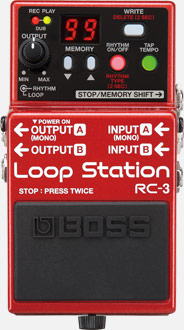
Maybe you’re like me: I’ve been putting off getting a looper pedal for a long time now – years, maybe. I’ve actually been using my buddy’s JamMan looper pedal when we perform together, so I have a taste that I need one. But now that I have a solo gig, I’m in a mad rush to get the best looper pedal for as little moolah as possible.
Like me, first you have to decide what features are important to you:
- What’s your budget?
- Does size matter?
- Do you need to save the loops you’ve created to come back to later?
- Do you need to be able to switch mid-song between different loops for verses, choruses, and other sections?
- Does your pedal need to be battery powered?
- Do you need some type of visual or audible metronome?
This pedal hits all of those marks:
- New, this pedal can be had for as little as $169.99 on Amazon. Used, I’ve seen it as low as $125. It’s not the absolute cheapest looper out there but, for everything it can do, there are not many other options.
- At 5 x 3 x 2.5 inches, this Boss pedal is a perfectly standard sized guitar pedal. It’s not the very smallest I’ve seen but it is nowhere near the largest.
- The RC-3 has a mostly straightforward method for saving loops and with 99 slots, it’s doubtful you’ll run out of space any time soon – in total, the looper can store three full hours of recordings. You can also back it up to your computer through a special USB (though this is one feature I have not experimented with). To save a loop, just pause the current loop and press the write button twice.
- Assuming you have already saved two or more loops to adjacent slots, the RC-3 can seamlessly switch between multiple loops during playback. All you have to do is hit the arrow up or down and it will switch to the next loop as soon as the current loop finishes.
- This pedal can run on battery power alone, but not for long. Boss warns that it pulls a lot of power, so it is best to use a wall outlet whenever possible – otherwise, it might die on you in the middle of a gig. It may be useful to know that the pedal only powers on when a 1/4″ is plugged into it’s output jack, regardless if you are using a OneSpot or the battery.
- Lastly, the RC-3 comes with some different rhythm options. You can loop without using the rhythm feature at all, or pick from a variety of different beats. The first option is just the sound of a hi-hat, which acts like a plain metronome. But it also comes with a couple of full-on beats built in. There is a tap tempo button and a light flashes to show you the quarter note, there is also a dedicated volume knob for the rhythm track.
What this pedal does well:
- In an era where a lot of looper pedals have become huge, intimidating monstrosities, the RC-3 fits a lot of usefulness into a small and humble package and all for a reasonable price.
- It’s super easy to save a loop to its own slot once you understand the two step process and it’s at least as easy to switch between loops.
- Although the packaging recommends using Boss’ power supply, it requires the same standard power supply as any of your other guitar pedals – so no fancy adapters, etc., like an Electro-Harmonix pedal would require.
- Although it obviously does not compare to playing with a live drummer, it’s quite handy to have some drum sounds built into the pedal to easily bolster your sound.
- The pedal includes a dedicated 1/8″ input to easily plug a phone, etc., into the pedal. You could use a drum or keyboard app on your phone, tablet, or computer to easily add different sounds and timbres to your loop.
- It is set up to interface easily with your computer’s DAW, sending .WAV files through USB.
What this pedal does not do well:
- It is hugely inconvenient to switch loops during a song unless you buy an attachment for the pedal (FS-5U or FS-6), and even then it could be more straightforward. Without the attachment, you would have to bend down to reach the pedal with one hand and press the small arrow button for up or down. It might not be so bad if you’ve looped everything you need and can take your hand off of your guitar for a moment, but if you’re also singing it’s not very convenient to pull the mic down with you for that moment. The FS-5U makes it easier to stop or switch the loop for an additional $35, but it still requires some fancy footwork to remember which combination of single or double-tapping does what.
- To save a loop to a certain memory bank slot, you first have to stop the playback. It’s not so bad if you’re just in your bedroom but, if you are trying to build the different sections of a song live on-stage, it could be a bit awkward. Of course, it’s no problem if you are using pre-saved loops.
- There are no buttons to incrementally adjust the tempo of the rhythm track. The tap tempo makes it easy to control, but I had a hard time accurately adjusting the tempo without stopping playback.
- I had a hard time clearing the loop to start again fresh without first starting playback again. You can turn the volume down on the pedal so that no one would hear you start the loop again after you already stopped it, but really this seems like an odd issue to build into a looper pedal.
- The default mode out of the box is Loop-Record-Playback. That means as soon as you record your first loop and it immediately starts playing back, you are still in record mode. That might be handy to some people, but it is quite annoying to me as I am likely to accidentally loop some wrong note or noise in that time right after I’ve finished my base-layer loop. It’s easy to undo mistakes once the loop has started, so it’s really not a problem; and it’s easy to permanently change the mode to Loop-Playback-Record, but I don’t know why the less desirable mode comes as the default – although, maybe I’m alone in that opinion.
In conclusion, the RC-3 Loop Station by Boss might be the best option for some guitarists. If you have limited real estate on your pedalboard, this pedal fits a lot of features into a small box. It is also super handy to be able to pre-save up to 99 different loops that you can recall in seconds. If you are primarily a bedroom guitarist just looking to noodle around over some different progressions, the RC-3 is the perfect looper pedal for you. If you are primarily a guitarist/instrumentalist performing within the context of a group, this might be your best option. If you are a solo performer trying to do it all or you’re the lead singer within a group, this might be the best option in this price range – but you should consider buying the add-on pedal FS-5U or FS-6 to more easily switch between loops or consider a larger unit with more dedicated controls, such as the Digitech Jam Man.
Overall:
Quest or Best?
The Quest Continues.
Follow My Blog
Get new content delivered directly to your inbox.
 Mono Guitars